
David M. Perrin holds the rank of Full Professor and has authored over 100 publications. Professor Perrin’s work amalgamates synthetic organic chemistry, molecular biology, physical organic chemistry and radiochemistry to address long-standing challenges at the interface of chemistry and biology where research outputs have had major impacts at a fundamental level as well as in several therapeutic applications, a theme that now unites his work.
Professor Perrin has received numerous competitively reviewed grants (CIHR operating grants, an NSERC accelerator grant, Junior- and Senior-scholar awards of the MSFHR, three Innovation Grants from the CCRSI, a New Directions grant from the Petroleum Research Fund, and a MSFHR Innovation-to-Commercialization grant), is an inventor on 5 patents (granted or pending), was awarded the Teva and Belleau Awards of the Can. Chem. Soc., is a co-founder of Alpha9Theranostics Inc., and is proud to have mentored postdoctoral fellows, graduates and undergraduates, many of whom now hold positions in academia and industry.
Professor Perrin has established himself as a leading researcher in bio-organic chemistry. Specifically, Dr. Perrin has generated creative solutions and gained new insights to the following long-standing problems in chemical biology: 1: synthesis of RNaseA mimics for destroying pathogenic mRNAs and selection of modified DNA aptamers for target recognition and sensing, 2: a chemical platform for one-step 18F-radiolabeling based on novel applications of boron-based chemistry for PET imaging cancer, 3: the synthesis of peptide natural products, notably alpha-amanitin; 4: Synthesis of novel heterocycles for the rationally designed recognition of DNA. Each project has generated a sustained publication record in high-impact, peer-reviewed journals and reflects a high degree of chemical/biological novelty, scientific rigor and long-term direction towards translational potential.
Awards and Activities:
Michael Smith Foundation for Health Research Junior Scholar (2002-2007)
Michael Smith Foundation for Health Research Senior Scholar (2008-2013)
Teva Award for Biological Chemistry (2015)
Bernard Belleau Award for Biological and Medicinal Chemistry (2019)
Co-founder: Alpha9 Theranostics Inc.
In the news:
https://www.bccrc.ca/dept/qrt/dept/et/articles/new-enzymatic-platform-harnesses-dnas-programmability-towards-creation-custom
New enzymatic platform harnesses DNA’s programmability towards the creation of custom radiopharmaceuticals

Researchers at BC Cancer Research Institute (BCCRI) and UBC Chemistry have created a new way to build radioactive DNA molecules that could help reimagine how radiolabeled drugs are built. Using enzymes that normally copy genetic material, scientists programmed synthetic DNA to carry cancer‑fighting isotopes in precise patterns, opening the door to developing drugs that could both image tumors and destroy them with the same molecule.
The work, a collaboration between Dr. François Bénard, distinguished scientist and senior executive director, research, BC Cancer and Dr. David Perrin, professor at UBC Chemistry, represents a natural progression for new applications in nucleic acid technologies, moving beyond earlier radioactive DNA systems toward medically relevant metals already used in cancer care.
“We’ve essentially repurposed the cell’s DNA‑copying machinery to build radiopharmaceuticals,” says Antonio Wong, PhD candidate at BC Cancer and UBC, and lead author on the project. “The enzymatic process takes less than 10 minutes and provides unprecedented control over how many radioactive atoms go into each molecule and exactly where they are positioned.”
This method harnesses DNA’s natural precision to build theranostic drugs that diagnose and treat disease simultaneously. By modifying DNA’s building blocks with metal‑chelating molecules, researchers can incorporate more than one medically relevant radioisotope into DNA, creating multi‑radiometalated molecules with defined compositions. As Dr. Perrin notes, the work “erases traditional boundaries between DNA chemistry and radiopharmaceutical development,” enabling the incorporation of multiple isotopes for different imaging and therapeutic modalities.
The team synthesized modified DNA letters attached to molecular cages that hold metals such as gallium‑68, indium-111, lutetium‑177, and terbium‑161. These radioactive building blocks are incorporated into DNA strands following a template, meaning the DNA sequence itself dictates which metals go where. Analytical techniques confirmed that metal ratios matched the template precisely.
While the study demonstrates a proof‑of‑principle platform, further pre‑clinical validation is needed. Researchers aim to test how these molecules behave in biological systems and develop them into clinical tools.
“This technology opens up exciting new possibilities for nuclear medicine applications, from diagnosis to treatment,” says Dr. Bénard.
See a video here: https://learning.media.ubc.ca/media/Video+Abstract+v2+ACIE.mov/0_0vw1ltq5
Read the full paper in Angewandte Chemie International Edition here.
***
DNA-guided platform paves way for more precise cancer treatments
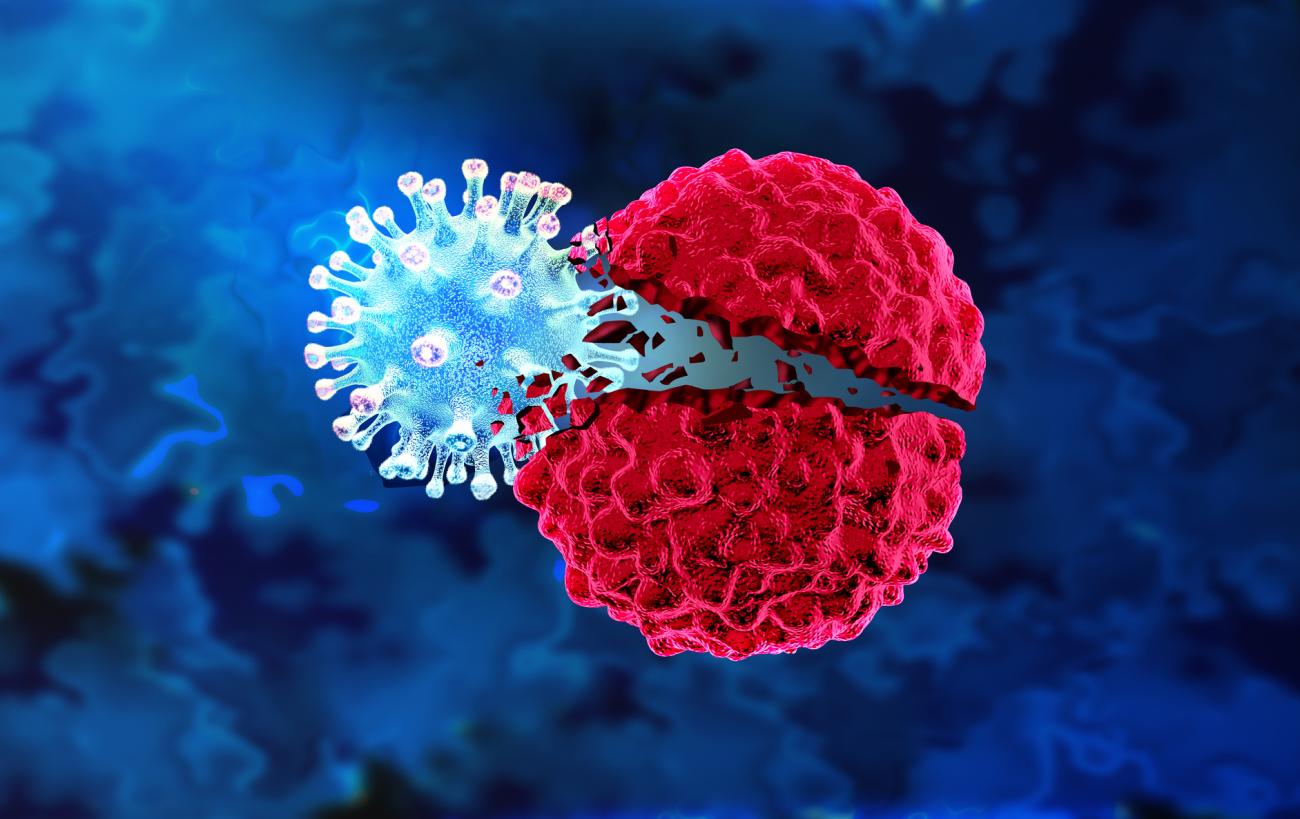
New ‘baited-SELEX’ technology merges small-molecule drug design with chemical biology to potentially improve treatment accuracy and reduce side effects.
A collaborative team of researchers from the Department of Chemistry at the University of British Columbia (UBC) and the Vancouver Prostate Centre (VPC) have developed a new method to design safer, more targeted cancer drugs. The platform, called baited-SELEX, uses DNA molecules to mimic antibodies and selectively target cancer cells while minimizing harmful side effects of current therapies.
Published in the Journal of the American Chemical Society, the study introduces a breakthrough approach for developing DNA-based therapeutics that could extend beyond prostate cancer to other forms of targeted radiotherapy and molecular treatments.
Co-led by Dr. David Perrin, professor in the UBC Department of Chemistry, and the research team at the Vancouver Prostate Centre led by Dr. Larry Goldenberg, the study developed a first-of-its-kind system for evolving DNA aptamers — short DNA strands that bind tightly and specifically to disease-related targets.
Our work on Prostate-Cancer-Targeting aptamers was featured locally at at Vancouver Coastal Health: https://www.vchri.ca/stories/2025/10/28/dna-guided-platform-paves-way-more-precise-cancer-treatments
New tracer could enable surgeons to see and hear prostate cancer
 A preclinical evaluation of a new ’dual-mode’ tracer agent shows promise in not only helping surgeons image and plan prostate cancer procedures, but also provide them with much more consistent and targeted guidance during surgery.
The agent uses a single tracer molecule labelled with Fluorine-18—a common isotope used in Positron Emission Tomography (PET) scans—for diagnostic imaging.
It also provides a one-step, widely accessible solution that would enable combined fluorescence-guided and radio-guided surgery.
“Precision medicine is increasingly being practised and developed to address the sophisticated treatment methods for diseases like cancer,” says Dr. David M Perrin, a University of British Columbia chemist and senior author on the paper, published in advance in the Journal of Medical Chemistry.
“Our tracer provides high-resolution visual guidance, but would also allow a surgeon to use a hand-held Geiger counter probes to ‘hear’ areas of high radiation density that would accumulate in cancerous tissue not immediately visible—whether it’s a lymph node, or distant metastasis, or local invasion in the like the bowel or the gut.”
The tracer targets and binds to PSMA—prostate-specific membrane antigen—a protein that is highly expressed on the surface of prostate cancer cells.
It not only has a high uptake by the tumour for PET images, but high optical brightness in the fluorescent mode without requiring special visual equipment.
“There’s a real lack of good clinical options when it comes to dual-mode PSMA tracers,” adds Dr. Perrin.
“So we feel this could fill an incredibly useful function in the treatment spectrum for prostate cancer, and potentially other diseases like larynx and ovarian cancer if the same approach can be applied to these.”
Dr. Perrin’s team and colleagues with the Department of Molecular Oncology at BC Cancer tested the tracer on mice with human tumours implanted in them…..story continues through link.
Our work on new dual-mode fluorescent-PET tracers for Prostate Cancer was picked up by AAAS’ Eureka Alert
https://www.eurekalert.org/news-releases/1095374

Our work on fluorescent PET tracers was also picked up at: https://ecancer.org/en/news/26928-new-tracer-could-enable-surgeons-to-see-and-hear-prostate-cancer
Dr. Perrin had the honor of giving the Madeleine Joullie Award lecture at the University of Pennsylvania in Nov 2019 for his work in chemical biology as applied to the synthesis of amanitin (a very humbling experience to have a photo with the very renowned Professor Joullie).
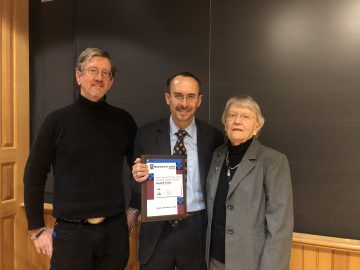
Accepting an award lecture plaque with Professors Pat Walsh and Madeleine Joullie – a great honor.
In recognition of the Perrin lab’s landmark amanitin synthesis, the dean of science featured this work, which was also featured in the Vancouver Sun:
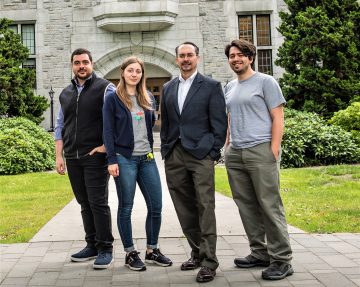
https://medium.com/ubcscience/amanita-3a3d21218322
https://vancouversun.com/news/local-news/fatal-death-cap-mushroom-may-ultimately-be-a-life-saver
Chemical and Engineering News ranked amanitin, “One of 8 Molecules of the Year”
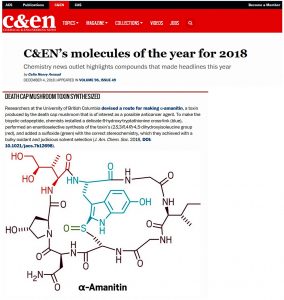
C&E News chose amanitin as one of 8 “Molecules of the Year in 2018”
Dr. Perrin won the prestigious Bernard Belleau award of the CSC in 2019
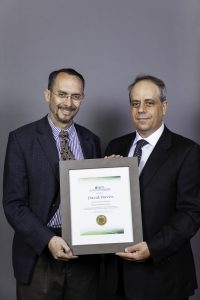
Dr. Perrin wins the Belleau Award (Canadian Society for Chemistry).
Dr. Perrin gave a lecture at the CSC-2019 on new RNA cleaving DNAzymes.
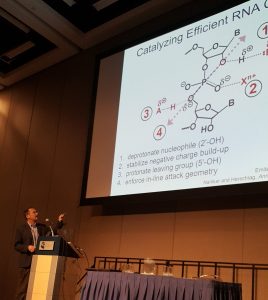
Explaining the mechanism for catalytic RNA cleavage at the CSC in Quebec.
Dr. Perrin was invited to give a talk at the International Round Table on Nucleic Acids 2018
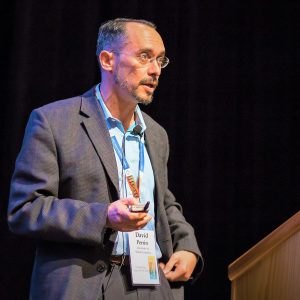
Trying not to be nervous when explaining the advantages of synthetically modified DNAzymes at the International Nucleic Acids Roundtable Conference.
Dr. Perrin’s work on mRNA-cleaving DNAzymes was covered in Vancouver’s “Science in the City”
Dr. Perrin’s work on antiviral DNAzymes was covered in Vancouver’s “Science in the City”
Dr. Perrin won the Teva Award of the CSC in 2015 for his work at the interface of chemistry and biology.
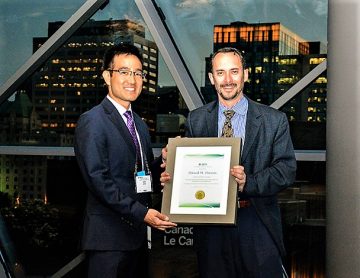
Receiving the Teva Award.
Drs. Perrin and Benard share a moment with their students in winning the one of 3 breakthrough publications of the Society of Nuclear Medicine 2015
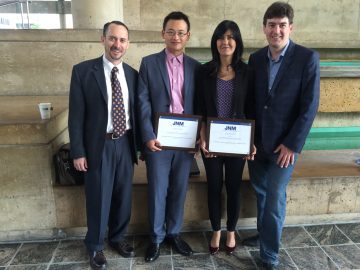
Celebrating our paper in J. Nucl. Med. that was awarded “one of three top scientific breakthroughs of 2015” by the Society of Nuclear Medicine. Photo: left-to-right: Perrin, Liu, Pourghassian, Benard.